The truth about Statins
Part 1: What are statins?
Because 'high' cholesterol has been deemed to be 'bad' for our health, over the past half century drug companies have looked on this belief as an opportunity to make money. The earlier drugs, produced in the 1960-80s were something of a disaster. In the late 1980s, however, a new class of drugs called statins were developed.
There are several statins: atorvastatin (Lipitor), fluvastatin (Lescol), pravastatin (Pravachol), rosuvastatin (Crestor), lovastatin (Mevacor) and simvastatin (Zocor). Each has a different brand name but they all work the same way.
Statins work by blocking the action of a certain enzyme (HMG CoA reductase) in the liver which is needed to make cholesterol. Statins are called HMG CoA reductase inhibitors.
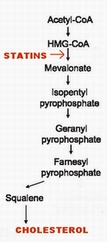 Statins block the enzyme in the liver that is responsible for making cholesterol. That enzyme is called hydroxy-methylglutaryl-coenzyme A reductase (HMG-CoA reductase for short).
Scientifically, statins are referred to as HMG-CoA reductase inhibitors.
In the simplified diagram on the right, different enzymes catalyse and control each of the steps from Acetyl-CoA at the top to cholesterol at the bottom.
Statins inhibit just one of them: the enzyme that converts HMG-CoA to Mevalonate. This dramatically reduces the amount of cholesterol the body can make.
Studies using statins have reported 20% to 60% lower LDL-cholesterol levels in patients on these drugs. Statins also produce a modest increase in HDL-cholesterol and reduce elevated triglyceride levels.
The statins are usually given in a single dose at the evening meal or at bedtime, to take advantage of the fact that the body makes more cholesterol at night than during the day.
Part 4: Statins, women and the elderly | Part 5: Statins or sunshine? | Part 6: Conclusion

