The truth about statins
Part 4: Statins, women and the elderly
The first thing to say is that not one of the many studies of statins has shown any benefit in terms of increased life-expectancy in any age group. However, there are two sections of the population in whom lower levels of cholesterol have really been shown to be life-threatening: These are women of all ages and elderly men.
Elderly men with high cholesterol live longest
It is very noticeable in nursing homes and veterans' hospitals that elderly patients with high cholesterol levels live the longest.
In 1997 two studies confirmed this observation. The first study was conducted by Leiden University in the Netherlands. This showed that for every 1 mmol/l (38.5 mg/dL) increase in blood cholesterol, deaths were reduced by 15%.[1]
The second study from Reykjavik Hospital in Iceland found that in their elderly patients, those whose blood cholesterol was over 6.5mmol/L (250mg/dL) had less than half the death rate (48%) of those patients whose cholesterol was a 'healthy' 5.2 (200mg/dL).[2]
Cholesterol and life-expectancy in women
In Part 2 of 'Low cholesterol increases your overall risk of death', we saw clearly that both men and women between the ages of 35 and 70 with high cholesterol have only half as many deaths as similar people with low cholesterol.
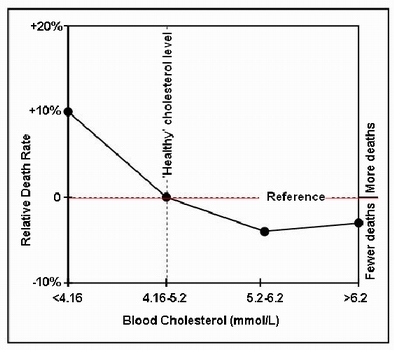
That 2007 study confirmed an earlier study looking at women alone. This, too, demonstrated clearly that as women's blood cholesterol rises so their death rate goes down.[3] In the graph on the left, you can clearly see that as cholesterol rises above the 'healthy' level, the total death rate falls; and, on the other hand, as blood cholesterol goes down below the 'healthy' level, the death rate rises quite steeply.
No evidence ttat statns extend life expectancy
In both these groups — elderly men and women of all ages — there is not one shred of evidence that taking statins will add as much as a day to their lives. And yet both groups are heavily targeted. Elderly men are thought to be 'most at risk' of a heart attack, so they are targeted most aggressively; women were seeming to be left out, so they, too, are now targeted to receive statins. Both groups are put at risk of serious side effects despite there being no evidence of benefit.
It gets even stranger: Although men in their 40s do tend to suffer a higher number of heart attacks if they have higher cholesterol levels, total mortality is highest in those men with the lowest cholesterol, that is, below 185mg/dL (4.8mmol/L).[4] The excess deaths are largely due to cancers. This is not surprising as cancer is a proven risk in people with low cholesterol levels. What may be surprising is the cholesterol level at which this increased risk is seen. That 'low' level of cholesterol, 185mg/dL (4.8mmol/l), is widely regarded as near the top end of the 'healthy' range!
References
1. Weverling-Rijnsburger AWE, et al. Total cholesterol and risk of mortality in the oldest old. Lancet 1997; 350: 1119-232. Jonsson A, Sigvaldason H, Sigfusson N. Total cholesterol and mortality after age 80 years. Lancet 1997; 350: 1778-9.
3. Hulley S. Editorial on Conference on low blood cholesterol. Circulation 1992; 86 (3): 1026-9.
4. Wannamethee G, et al. Low serum total cholesterol concentrations and mortality in middle aged British men. BMJ 1995; 311: 409-13
Part 4: Statins, women and the elderly | Part 5: Statins or sunshine? | Part 6: Conclusion

